publications
2024
-
 Sign Language Synthesis: Current Signing Avatar Systems and RepresentationVíctor Ubieto, Jaume Pozo, Eva Valls, and 2 more authors2024
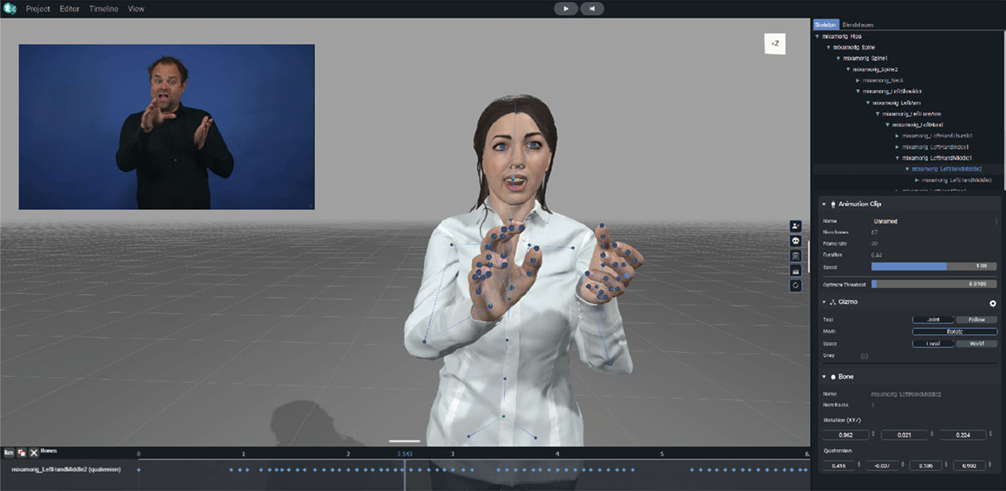
Animating avatars for sign languages (SLs) is a challenging task due to the high quality and naturalness requirements. Recent publications and media show that virtual avatar quality is evolving, yet remain greatly constrained by the predefined set of animations available, crafted by skillful animators. In this research, we propose two different but complementary systems, focusing on sign animations synthesis and scalability. The first uses Behaviour Markup Language (BML) to drive the avatar procedurally from textual instructions, derived from HamNoSys, SiGML and the Facial Action Coding System (FACS). Several techniques are employed for driving the avatar such as geometric inverse kinematics and blendshape weight modulation. The second system resorts on widespread low-end technology such as webcams to generate 3D animations from simple video by applying different Machine Learning (ML) techniques. In our implementation, both systems are coupled with an editor for tweaking the resulting 3D animations. It also provides a point-and-click interface for generating BMLs through sliders and boxes that can be greatly adjusted in time and duration. Hence, users can generate new content adapted to their circumstances without the need of specialised equipment or knowledge.
@inbook{Ubieto2024,
  author = {Ubieto, V{\'i}ctor and Pozo, Jaume and Valls, Eva and Cabrero-Daniel, Beatriz and Blat, Josep},
  editor = {Way, Andy and Leeson, Lorraine and Shterionov, Dimitar},
  title = {Sign Language Synthesis: Current Signing Avatar Systems and Representation},
  booktitle = {Sign Language Machine Translation},
  year = {2024},
  publisher = {Springer Nature Switzerland},
  address = {Cham},
  pages = {247--266},
  isbn = {978-3-031-47362-3},
  doi = {10.1007/978-3-031-47362-3_10},
  url = {https://doi.org/10.1007/978-3-031-47362-3_10},
}
2022
-
 Sign Language Machine Translation and the Sign Language Lexicon: A Linguistically Informed ApproachIrene Murtagh, Víctor Ubieto Nogales, and Josep BlatIn Proceedings of the 15th biennial conference of the Association for Machine Translation in the Americas (Volume 1: Research Track), Sep 2022
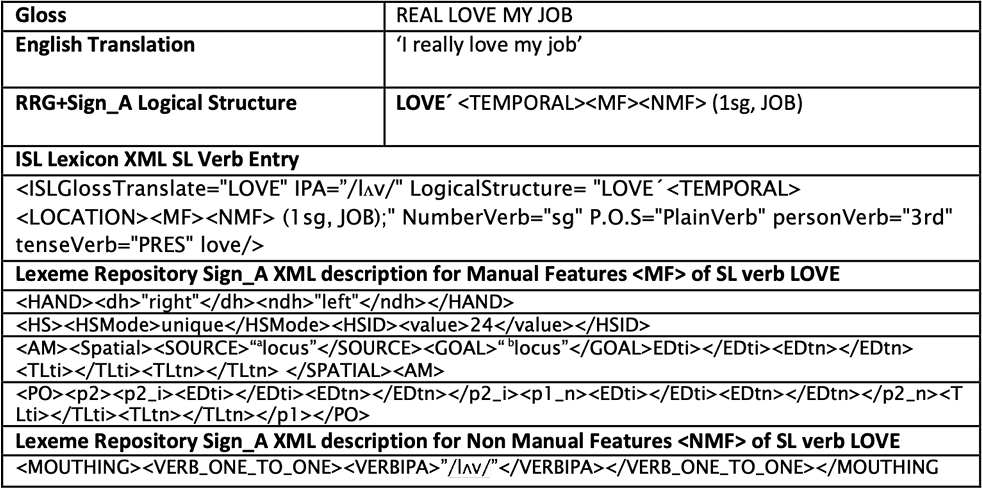
Natural language processing and the machine translation of spoken language (speech/text) has benefitted from significant scientific research and development in re-cent times, rapidly advancing the field. On the other hand, computational processing and modelling of signed language has unfortunately not garnered nearly as much interest, with sign languages generally being excluded from modern language technologies. Many deaf and hard-of-hearing individuals use sign language on a daily basis as their first language. For the estimated 72 million deaf people in the world, the exclusion of sign languages from modern natural language processing and machine translation technology, aggravates further the communication barrier that already exists for deaf and hard-of-hearing individuals. This research leverages a linguistically informed approach to the processing and modelling of signed language. We outline current challenges for sign language machine translation from both a linguistic and a technical prespective. We provide an account of our work in progress in the development of sign language lexicon entries and sign language lexeme repository entries for SLMT. We leverage Role and Reference Grammar together with the Sign_A computational framework with-in this development. We provide an XML description for Sign_A, which is utilised to document SL lexicon entries together with SL lexeme repository entries. This XML description is also leveraged in the development of an extension to Bahavioural Markup Language, which will be used within this development to link the divide be-tween the sign language lexicon and the avatar animation interface.
@inproceedings{murtagh-etal-2022-sign,
  title = {Sign Language Machine Translation and the Sign Language Lexicon: A Linguistically Informed Approach},
  author = {Murtagh, Irene and Nogales, V{\'i}ctor Ubieto and Blat, Josep},
  editor = {Duh, Kevin and Guzm{\'a}n, Francisco},
  booktitle = {Proceedings of the 15th biennial conference of the Association for Machine Translation in the Americas (Volume 1: Research Track)},
  month = sep,
  year = {2022},
  address = {Orlando, USA},
  publisher = {Association for Machine Translation in the Americas},
  url = {https://aclanthology.org/2022.amta-research.18/},
  pages = {240--251},
}
2021
- Extensible Spherical Fibonacci GridsRicardo Marques, Christian Bouville, Kadi Bouatouch, and 1 more authorIEEE Transactions on Visualization and Computer Graphics, 2021
2006
- Fibonacci grids: A novel approach to global modellingRichard Swinbank and R. James PurserQuarterly Journal of the Royal Meteorological Society, 2006
Abstract Recent years have seen a resurgence of interest in a variety of non-standard computational grids for global numerical prediction. The motivation has been to reduce problems associated with the converging meridians and the polar singularities of conventional regular latitude–longitude grids. A further impetus has come from the adoption of massively parallel computers, for which it is necessary to distribute work equitably across the processors; this is more practicable for some non-standard grids. Desirable attributes of a grid for high-order spatial finite differencing are: (i) geometrical regularity; (ii) a homogeneous and approximately isotropic spatial resolution; (iii) a low proportion of the grid points where the numerical procedures require special customization (such as near coordinate singularities or grid edges); (iv) ease of parallelization. One family of grid arrangements which, to our knowledge, has never before been applied to numerical weather prediction, but which appears to offer several technical advantages, are what we shall refer to as ‘Fibonacci grids’. These grids possess virtually uniform and isotropic resolution, with an equal area for each grid point. There are only two compact singular regions on a sphere that require customized numerics. We demonstrate the practicality of this type of grid in shallow-water simulations, and discuss the prospects for efficiently using these frameworks in three-dimensional weather prediction or climate models. © Crown copyright, 2006. Royal Meteorological Society